Stage 05 · The Book
The gutter
The fold eats the centre of a spread, which decides what can be printed across one.
Entry 1 of 4 in The Book, the fifth of seven stages between the shutter and the shelf.

The fold that takes its share
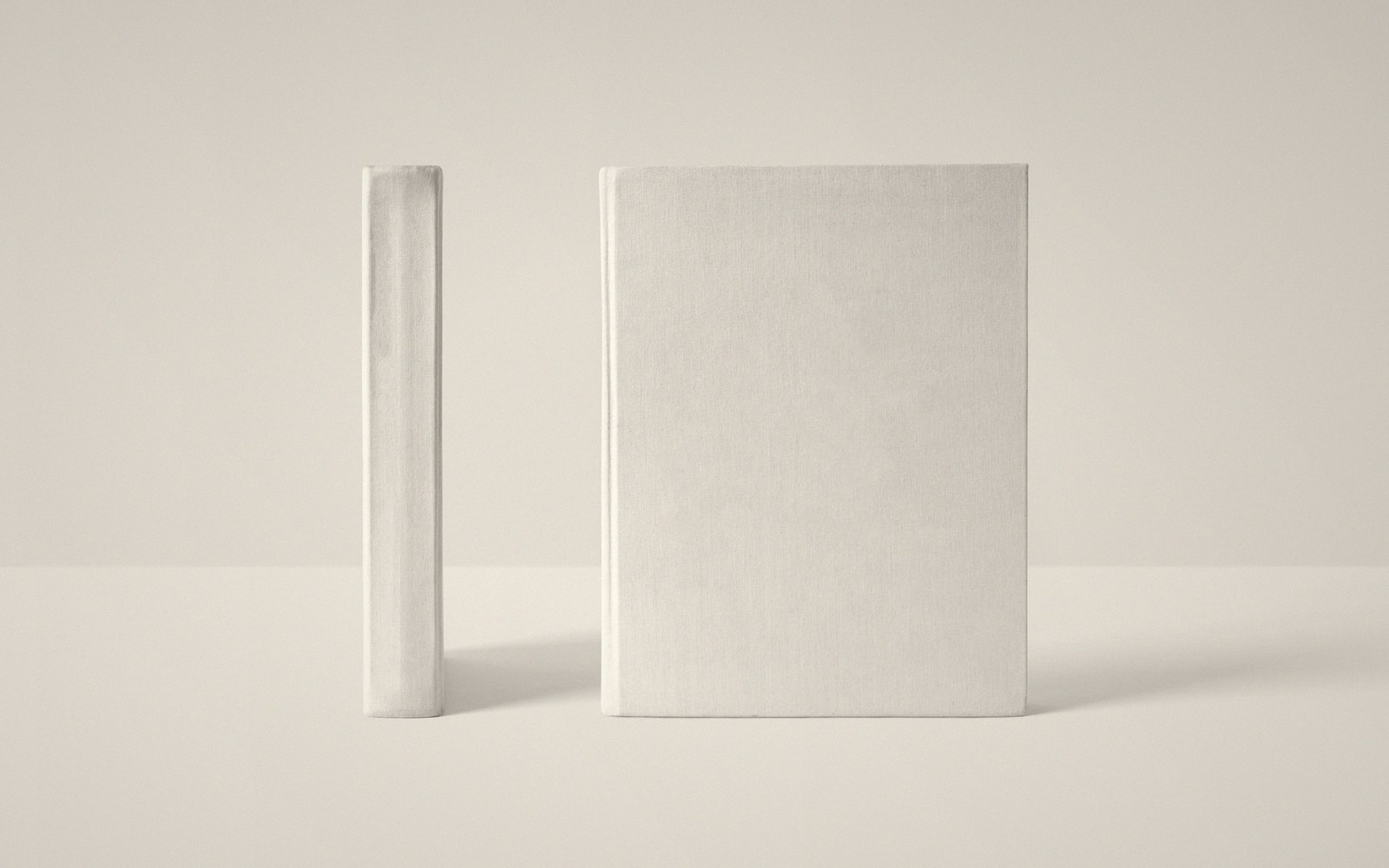
The gutter is the inner margin where two pages of a bound book meet the spine. On a flat screen or a loose print, an image occupies whatever space it is given. In a bound book, the gutter takes a share of that space without asking, and what sits there may vanish entirely — pressed into the fold, lost to the curve of the paper as the pages meet the spine.
How much it takes depends on the binding. A perfect-bound book — pages glued to a square spine — holds its pages under tension. Open one and the inner margins resist; anything close to the fold bends away from view. A sewn-signature binding opens more readily, especially after the book has been read a few times, but it never lies fully flat without force. Lay it face-down under pressure and you damage it. A Swiss-broche or stab-binding opens not at all across the gutter. Only a spiral or Wire-O binding gives a genuinely flat opening, and neither is what most photobooks are.
The practical consequence is simple: the gutter is not neutral ground. A face centred across a spread will lose the nose to the fold. A horizon running through the gutter will step — the left-hand page and the right-hand page will not align at their inner edges the way they aligned on your monitor, because paper has thickness and signatures have bulk. Experienced book designers speak of this as gutter compensation: the image on each page is shifted slightly outward so that the optical centre of the spread falls where the eye expects it, accounting for what the fold will consume.
What this means for the edit
The decision is not purely technical. It is an editorial one, made before any file goes to the printer, and it starts with the frames themselves.
A photograph with its subject cleanly on one side — figure left, open space right, or the reverse — can span a gutter without cost. The dead zone falls in the negative space, and the spread reads as a single image. A photograph whose energy runs through the centre, whose subject is the middle of the frame, usually cannot. The gutter will bisect the thing you are asking the reader to look at, and no amount of compensation fully recovers it.
This is why sequencing and book structure must be thought together. Which frames are strong enough to hold a full page alone? Which pairs, placed side by side on the same spread, create a relationship — the gutter acting as a visual pause rather than a wound? And which photographs, if any, genuinely earn the drama of a gatefold: a folded leaf that opens out to give an image double the spread width, sidestepping the gutter entirely at the cost of a more complex bind.
The dummy is where this gets tested physically, not on screen. Printing the spreads at final size, folding and binding them roughly, and then opening the mock-up under normal reading conditions will show you immediately what the gutter is eating. The monitor will have lied. The dummy does not. A work print of every spread, bound in signatures that match the final specification, costs an afternoon and saves far worse decisions later.
There is also a subtler problem: the gutter affects images differently depending on where in the book they fall. How far a spread opens varies with its position in the book block and with where it falls within its signature. A spread that works at page eight may not work at page forty. The solution is to test the sequences in position, not in isolation, which means building the dummy to the correct page count and paper weight — not a rough approximation of it.
The gutter is not an obstacle to be engineered away. It is a condition of the form, and working with it rather than against it is part of what makes a book feel like a book rather than a digital layout that happened to be bound.